Wednesday, September 23, 2020

WHY YOU SHOULD DEEP CLEAN TO HELP PREVENT COVID-19


WHY YOU SHOULD DEEP CLEAN TO HELP PREVENT COVID-19


We all want to keep our families safe, and COVID-19 is a top concern for most people these days. We hear a lot about the things we can do to protect ourselves and our children when we have to go out in public, but what about protecting the people we love when they’re in our homes? Deep cleaning, and doing it often, is key.

The CDC and WHO both promote the importance of a clean and sanitized environment in helping to stop the spread of COVID-19. The CDC has even provided specific guidelines to help you clean and disinfect your home properly.

What is the difference between cleaning, sanitizing, and disinfecting?

These words are often tossed around as if they are interchangeable, but they aren’t. It’s key to understand that cleaning alone, while a vital first step, does not kill bacteria or viruses. Cleaning refers to using water and a product like soap to remove debris from a surface. This step should never be skipped, but it should always be followed with sanitizing or disinfecting.
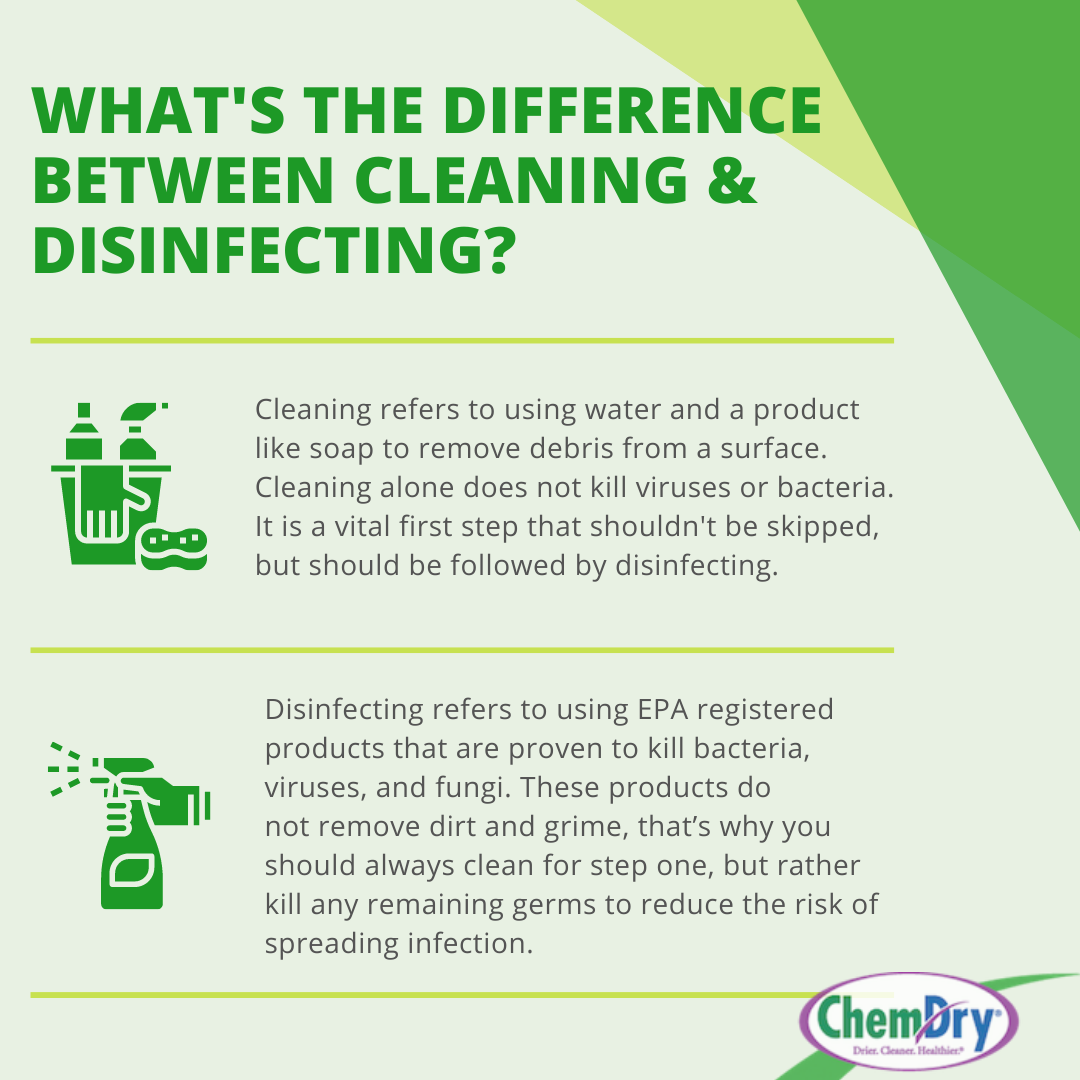
What's the difference between cleaning & disinfecting?


Sanitizing and disinfecting refer to using EPA registered products that are proven to kill bacteria, viruses, and fungi. These products do not remove dirt and grime, that’s why you should always clean for step one, but rather kill any remaining germs to reduce the risk of spreading infection. You can find a list of EPA registered disinfectants approved for use against SARS-CoV-2 here.


How can Chem-Dry help me deep clean my home?

Chem-Dry is proud to offer our new 3-step MicroPro Shield Service to help you keep your home clean and your family safe. The first step, DISINFECT is the core Chem-Dry disinfecting process where our professional technicians apply a hospital-grade, EPA-registered disinfectant by wiping down high-touch point areas and electrostatically spraying surfaces throughout each area serviced. Our disinfectant is food-contact-surface safe and is effective at eliminating 99.9% of bacteria from soft and hard, non-porous surfaces.1

The second step, PROTECT is an upgrade from our basic disinfecting services to also include the 90-day residual antimicrobial benefits of our MPS-90 process. This residual layer is a microscopic layer of spikes that continue to kill microbes like bacteria on contact, keeping surfaces protected for up to three months! When microbes like bacteria come into contact with the layer of spikes, the spikes mechanically kill them. The spikes pierce and rupture the microbe’s cell membrane, preventing microbes from mutating and adapting into superbugs.2

The third step is to CERTIFY that the job was done according to proper protocols and all areas treated were disinfected/sanitized and protected for up to 90-days.

Call your Local Carpet Cleaner today!

1 Based on EPA registration # 82972-1. Hard surface bacteria tests were based on independent lab testing associated with EPA registration # 82972-1; sealed stone and VCT surfaces were evaluated for 38 pathogens including bacteria, germs and viruses. Our sanitizer associated with EPA registration # 82972-1 has been approved by the EPA for use against SARS-CoV-2, the cause of COVID-19.
2 Based on EPA registration # 87583-3.

Best Carpet Cleaner for Pet Urine - Professional Carpet and Rug Cleaning

Monday, August 24, 2020

Hardword versus Carpet

A look at factors you should consider in your flooring decisions

Sometimes it can seem as though everyone has an opinion on the “best” kind of flooring for a home, but the truth is that every home is different. There are a lot of factors that can affect your decision on what kind of flooring you want in your home, including budget or cost, ease of installation and upkeep, quality, and even the people living in your home.

So, to help you out, we have broken down each essential category and provided a direct comparison of each one, so that you can make the absolute best decision for both your home and your family.

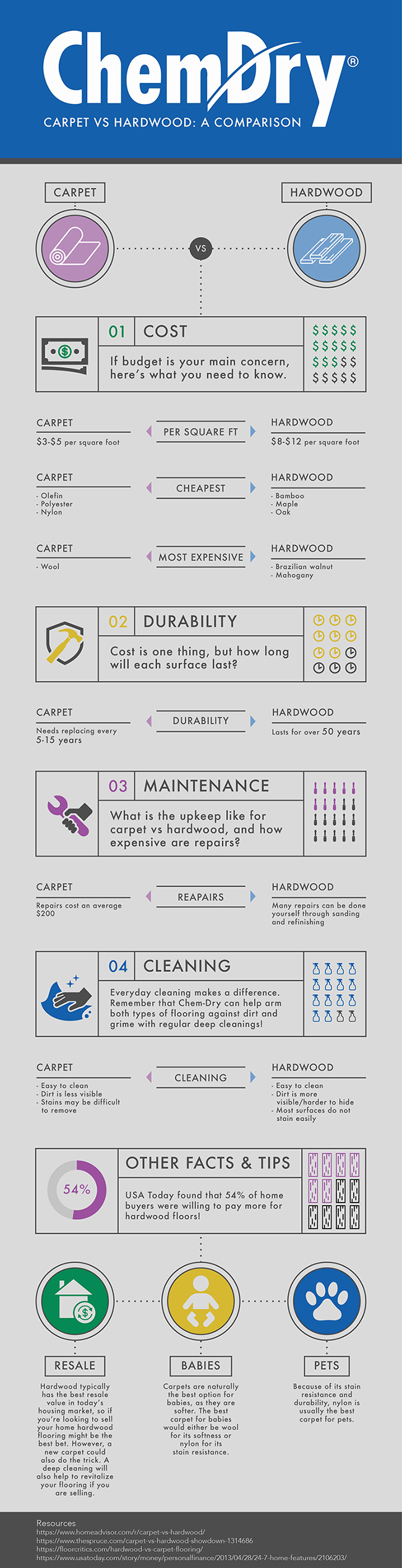
Infographic comparing carpet and hardwood flooring options by Chem-Dry

Carpet versus Hardwood: A Comparison

Costs

If budget is your main concern, here’s what you need to know.

Carpet: $3-$5 per square foot

Cheapest: Olefin, Polyester, Nylon

Most expensive: Wool

Hardwood: $8-$12 per square foot

Cheapest: Bamboo, Maple, Oak

Most expensive: Brazilian walnut, Mahogany

Durability

Cost is one thing, but how long will each surface last?

Carpet: Needs replacing every 5-15 years

Hardwood: Lasts for over 50 years

Maintenance

What is the upkeep like for carpet vs hardwood, and how expensive are repairs?

Carpet: Repairs cost an average $200

Hardwood: Many repairs can be done yourself through sanding and refinishing

Cleaning

Everyday cleaning makes a difference. Remember that Chem-Dry can help protect both types of flooring against dirt and grime with regular deep cleanings!

Carpet: Easy to clean; dirt is less visible; stains may be difficult to remove

Hardwood

Easy to clean; dirt is more visible/harder to hide: most surfaces do not stain easily

Other Facts & Tips

Resale

Hardwood typically has the best resale value in today’s housing market, so if you’re looking to sell your home hardwood flooring might be the best bet. However, a new carpet could also do the trick. A deep cleaning will also help to revitalize your flooring if you are selling your home.

USA Today found that 54% of home buyers were willing to pay more for hardwood floors!

Best Carpet for Babies

Carpets are naturally the best option for babies, as they are softer and warmer. The best carpet for babies is either wool for its softness or nylon for its stain resistance.

Best Carpet for Pets

Because of its stain resistance and durability, nylon is usually the best carpet for pets.

Resources

https://www.homeadvisor.com/r/carpet-vs-hardwood/

https://www.thespruce.com/carpet-vs-hardwood-showdown-1314686

https://www.usatoday.com/story/money/personalfinance/2013/04/28/24-7-home-features/2106203/